Showing posts with label hummingbirds. Show all posts

Sunday, August 21, 2011

Hummingbird rescue!

In the yard this morning, as I watched the chickens scratching, pecking, and dirt bathing, I noticed a male Broad-billed Hummingbird that seemed in distress. He flitted from one feeder to the next, trying each of a half dozen in turn without staying long enough for a decent drink. When he finally sat a moment and turned his profile to me, I saw the problem: a crusty black bump at the tip of his bill.

I ran inside and found Tom. "There's a Broad-billed out there with something on his bill! Can you help me trap him?"

Tom watched out the window until the bird reappeared. "The remote control on the trap is still not working," he said. (It got soaked in a ferocious thunderstorm last week and hasn't been the same since.) "Why don't we try luring him into the chicken coop?" Brilliant.

We hung two feeders, one in the doorway and another inside, and within minutes the desperate bird tried to drink from both feeders before flying toward the back of the coop. With a little gentle corraling from Tom, our patient was soon in hand.
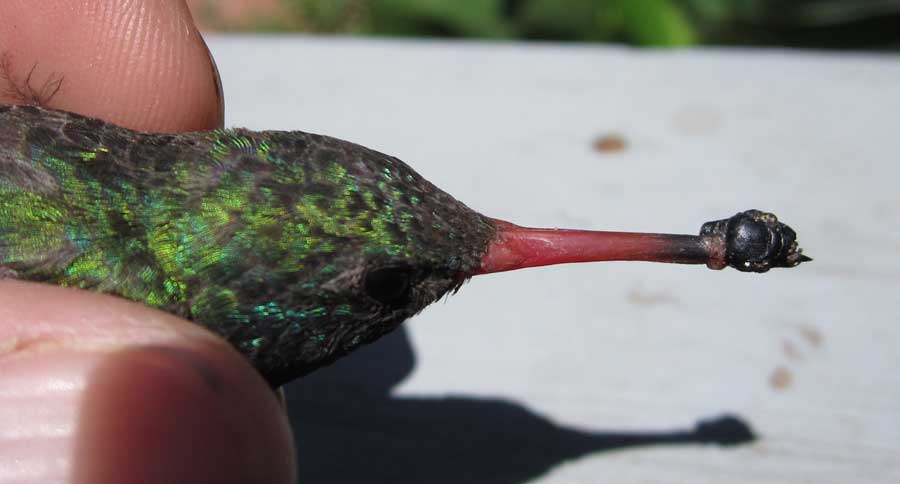
The bump is the head of a bee or wasp, shackling the bill and
preventing the bird from feeding properly.
Up close, I confirmed that the lump was the hard carapace of an insect, a bee or wasp. Only the head remained, impaled on the bill. The bird couldn't insert his bill into most feeders or flowers, nor could he open it to catch insects. I'd seen this sort of thing before both in person and in photos, but what I'd never seen until now was injury to the bill from the carcass.
A ring of raw, swollen bill tissue on the body side
of the insect's head is a bad sign.

A hummingbird's bill is mostly living tissue, vulnerable to damage from the sharp edges of the insect's exoskeleton, decomposition of its tissues, or both. This bill looked bad, as though the tip might be necrotic. Removing the bird's handicap would not be easy or painless. A pang of dread clutched at my heart.

Armed with high-power reading glasses and banding forceps, I performed the removal as gently and quickly as possible. The bird cried as the crusty carcass came off in bits, and I kept apologizing for the pain I was causing him (he couldn't possibly understand, but it eased my own pain a little). Once it was off, a little blood welled up in the ring-shaped wound—a sign of healthy underlying tissue. He stopped crying and experimentally licked out his tongue. Definitely a good sign.

I washed the wound, applied a thin film of antibiotic ointment to the top and bottom of the bill (taking care to avoid the edges where it might get into his mouth), and gave him a long drink from a feeder. To recognize him if he visited us again, Tom and I banded, measured, and weighed him. He felt like nothing in my hand, and the scale confirmed that he had been slowly starving. Just 2.8 grams, compared to 3.2 to 3.7 grams for healthy, unencumbered male Broad-billeds that we have banded recently.

The wound looks awful, but the pink color and slight bleeding
are signs of healthy tissue.

Back outside, he lay in my hand for a few seconds before departing. Hummingbirds are tough, and this little survivor is welcome to stay in our yard as long as he needs to recuperate.

Hummingbirds and Butterflies (Peterson Field Guides/Bird Watcher's Digest Backyard Bird Guides)Attracting and Feeding Hummingbirds (T.F.H. Wild Bird Series)

Sunday, February 27, 2011

Anna's in the snow


A male Anna's visited our hummingbird feeder during this morning's mini-blizzard. He could barely hang on as the feeder swung in the wind and snow pelted his face. Not wanting to make his morning even more stressful, I waited until he left to put out fresh, warm sugar water.

It's been a grim winter for Arizona's hummingbirds. Many died in the Big Freeze of 2011, and many others had to be rescued. Hummingbirds in Tucson and Phoenix, where temperatures rarely stray below freezing, seemed more affected than those wintering at higher elevations. Here at 5000 feet in the foothills of the Mule Mountains, our two or three Violet-crowneds and handful of Anna's managed to ride out the January cold snap, but most disappeared after the all-time record low on the second night of the Big Freeze (0° F./-18° C.).

The following morning's weather was much improved, so I'm hoping that they rode out the worst and departed as soon as possible, as hummingbirds wintering in much colder climates have been observed to do. We're still hosting at least one female Anna's in addition to this male, but there's been no sign of a Violet-crowned since the first day of the freeze (at 8 a.m., during the second feeder change of the day). Even with a bustling clientele of Northern Cardinals, Pyrrhuloxias, Green-tailed Towhees, Gambel's Quail, and many more, the feeding station seems forlorn without an occasional flash of violet blue.

It will be weeks before I can tell how much of our hummingbird garden survived, but in the meantime I'll be escaping waaaay south of the border (Belize and Tikal) for a couple of weeks, leading a birding and natural history tour for SABO.

Wednesday, September 29, 2010

September surprise


So, yesterday morning I was out on the patio supervising the chickens' free-ranging activities and watching the show at the feeders when I notice this hummer sitting on the far feeder across from a Rufous/Allen's...


Something about it set sirens off in my head. As the Rufous/Allen's backed away, the other bird raised its head in response...


...revealing the long, curved bill of a Lucifer, the first confirmed in our yard in the nearly 15 years since we moved in and put up the first feeders.


A Field Guide to Hummingbirds of North America (Peterson Field Guides)The species nests here in the Mule Mountains, so hopefully we'll see more of them next season now that this lady has found our garden and feeders. With a Calliope that Tom spotted later in the afternoon, our 48-hour hummingbird tally came to a whopping 8 species: Broad-billed, Violet-crowned, Black-chinned, Anna's, Lucifer, Calliope, Broad-tailed, and Rufous (mostly "Rufous/Allen's," but most of the juvenile males are identifiable to species by their tail feather shapes). —SW

Wednesday, December 23, 2009

Desert snow

We woke up this morning to this:


After one of the worst "monsoons" on record and a virtually rainless fall, we'll take our precipitation any way we can get it. Melting, it registered .35" - not too bad.

It's the chickens' first snow, so I let them out to scratch around in it.

While supervising their explorations, I noticed that the hummingbird feeder was caked with snow. The feeder went dry while we were away for a few days, and I hadn't seen or heard a hummer since we returned, but I dutifully minced through the slush and brushed the ports clear. I hadn't taken three steps back when a male Anna's appeared out of nowhere.

Within a half hour a female Anna's and a Violet-crowned also came to drink, so I guess they've forgiven us for neglecting them while we were away watching other hummingbirds.

The chickens are only allowed out when we're there to supervise. We love our chickens, but we also love our raptor neighbors and don't want to lead them into temptation. We haven't noticed regular visits from the Cooper's Hawk that used our water feature as her personal spa the last two winters, but the local Red-tail is a proven bird hunter. One morning as I stepped out to check on the chickens, a flutter caught my eye. There was the Red-tail atop a nearby utility pole. Hey, neighbor, I thought. Another flutter, and a double-take: the hawk wasn't alone.

He can have all the pigeons he wants, and I've never caught him eyeing the girls, but better safe than sorry.

City Chicks: Keeping Micro-flocks of Chickens as Garden Helpers, Compost Makers, Bio-reyclers, and Local Food Producers
A Photographic Guide to North American Raptors  A Field Guide to Hummingbirds of North America (Peterson Field Guides)

Friday, April 24, 2009

An Earth Day treat

The week of Earth Day is a great time to be birding in southeastern Arizona, but White-eared Hummingbird isn't on the list of anticipated delights. On Earth Day, this studly male was putting on a show for visitors to Beatty's Guest Ranch in Miller Canyon. He's about three weeks early, but based on his use of the same perches this is the same male that I videoed last summer.

Though you can't see the brilliant green and violet from this angle, it's currently his most flattering angle. From the front he's got a pinfeather sticking out of his crown like a tiny unicorn's horn—a bit goofy looking. —SW

Saturday, August 16, 2008

The good, the bad, and the bugly

Hummingbird numbers are rising. Though there seems to be plenty of natural nectar from both native and garden sources, they're hitting our feeders hard. This gorgeous Broad-billed has been one of our regulars this summer:The "monsoons" have been generous this year, cloaking southeastern Arizona in an abundance of green rarely seen in the desert. Unfortunately, some of that green consists of weedy annuals such as the pigweed (Amaranthus palmeri) that grows so fast that in a few days of inattention it's shot up to five feet and is already setting seed. It likes disturbed soil, and we've been disturbing the soil on our property pretty seriously lately in an effort to control the highly invasive Ailanthus (an epic struggle involving our cars and a tow cable as well as garden tools and herbicides). At least pigweeds are edible, though I'm not sure collecting enough seeds to make candy from is worth the time, sweat, and prickled fingers.

In between the weeds, though, our garden is blooming like crazy. The "Red Bed," a sheltered corner of the yard where we've concentrated our less desert-adapted hummingbird flowers, is pretty colorful right now, with Desert Columbine (Aquilegia desertorum), Coral Honeysuckle (Lonicera sempervirens), and seven varieties of salvias in bloom. Here's Salvia microphylla 'Hot Lips':

All four flowers in the photo above are on the same plant, which is the main attraction of this unusual "sport." The flowers are usually bicolored but may be solid red or solid white, apparently determined by temperature (individual flowers don't change color like a mood ring, though). Right now our plant has all three. It's not a huge hit with the hummers, but it's still worth having around just for this bizarre trait.

The Mountain Sage (Salvia regla, acquired from salvia maven Rich Dufrense), two varieties of Mexican Bush Sage (Salvia leucantha), and native Transpecos Morning-glories (Ipomoea cristulata) should be blooming soon, but I'm starting to lose hope of ever seeing the alien-looking flowers of the Aztec (or Jacobean) Lilies (Sprekelia formosissima) given to us by a friend. Our sunny front walk is also bordered with flowers, including two varieties of wild-type cannas (Canna sp.) and four types of lantana (grown especially for butterflies).

The rains have also given insect populations a big boost and, like the plants, not just the nice ones. The "sabertoothed gnats" (a type of black fly, apparently) are on the decline now, but a couple of weeks ago we didn't dare go out without full-body protection (the damned things act like DEET doesn't exist). We haven't found any kissing bugs in the house since I posted on them a few weeks back, but we're still getting bitten occasionally. Grasshopper populations are on the rise, too, just as our tomatoes, peppers, and squash are finally starting to set fruit. Then there's the carpenter bees that slash open the salvia flowers, ruining them for the hummingbirds and butterflies (I can't find the reference just now, but they can see red better than other bees and feed on other red flowers such as ocotillo).

But the bug bounty isn't all bad - we've also got lots of butterflies, White-lined Sphinx Moths, and occasional surprises. This week this formidable creature dropped in for some watermelon:
This is a Long-jawed Longhorn Beetle, Trachyderes mandibularis, the first we've seen in our yard. (Addendum: He can fly, even with that outlandish headgear, but it's like an elk taking wing.) The brilliant green beetle behind it is a Fig Beetle or Green June Beetle, Cotinis mutabilis.

With all the rain, our little water features aren't getting much use. I miss all the activity from the dry season, when one corner of our yard was like a popular neighborhood pub. Here are a few highlights:

Juvenile Costa's hummingbird bathing in the solar fountain


Male Bronzed Cowbird

Male Varied Bunting (a first for our yard)

Male Pyrrhuloxia

The hummingbird and butterfly action should get even better as we slide toward September, and there may be other surprises in store. Stay tuned!

--SW

Monday, June 23, 2008

Double dipping on BBBB quotes

Google Alerts tipped me off to a mention of SABO in a post over at sustainablog.org. Checking it out, I discovered that contributor Justin Van Kleeck repeated my quote from Mike Klesius's January 2007 National Geographic article on hummingbirds. Scrolling down, I was even more delighted to see that the first comment paraphrased one of Tom's favorite observations about hummingbirds as quoted by Richard Conniff in "So tiny, so sweet--so mean," an article originally published in Smithsonian Magazine (September 2000) and condensed and reprinted by Reader's Digest (May 2001).

You can read the Nat Geo article here, but I couldn't find the full Smithsonian article on line. Too bad, since it earned author Richard Conniff the John Burroughs Association essay award for 2000. You can read part of it here. (This should come as no surprise, but I was the other guide Conniff quoted in his opening paragraphs.) --SW

Saturday, May 24, 2008

Heavy weather

We've just endured a wretched three days here in beautiful southeastern Arizona. A fierce low pressure system brought savage winds, rain, sleet, hail, and snow to our little corner of paradise. The winds started when temperatures were running slightly above normal (hot, in other words) and humidities very low, which played heck with tender young leaves. Gusts up to 58 mph were recorded at the Bisbee-Douglas airport, and a substantial portion of our roof is scattered over our yard and neighboring properties. Our newly planted vegetables and many of our flowers look like they've been sandblasted.

Then on Wednesday night the temperatures took a nosedive. Thursday morning's bird walk in Miller Canyon was seriously chilly, but there was lots of activity as tired, hungry birds tried to recover from the wind and cold, and the deep canyon protected us from the winds. I felt especially bad for the Spotted Owl family 50+ feet up in a huge fir -- their nest was swaying so much that they could have used scopolamine patches. (I so wish I'd had a digiscoping camera to capture the fuzzy little face poking our from under its mama's wing.) Back at Beatty's Guest Ranch, hungry hungry hummingbirds, including two White-eareds and a Lucifer x Calypte hybrid, put on quite a show. [Subsequent observations revealed this bird to be a Lucifer-like hybrid, probably Broad-tailed x Costa's.]

The winds raged on through Thursday night, the staccato beat of rain, sleet, and hail against our bedroom window making it hard to sleep. It dried out a bit yesterday morning, but the cold, gusty conditions continued through the afternoon and into the night. As we made our way to yesterday afternoon's hummingbird banding session in Carr Canyon, the peaks of the Huachuca Mountains were thickly capped with snow, something we've never seen this late in the season in our 20 years in Arizona. Our banding crew was bundled up like Inuits except for me -- my burliest turtleneck sweater and woolly socks weren't quite warm enough, so I ended up borrowing a jacket from one of the volunteers. The weather had the birds in a much less cooperative mood than usual, but gentle application of warm breath seemed to calm them down. A male Broad-billed, two male Magnificents, two female Anna's, a female Black-chinned, and a premature escapee male Blue-throated were our rewards for soldiering through.

At least the storm brought some precipitation, which should compensate a bit for the destructiveness of the winds and cold. I'm expecting to see a renewal of nesting activity over the next week or so as birds that lost their eggs and nestlings start from scratch. A pair of Greater Roadrunners in lower Carr Canyon seemed to be getting a head start yesterday afternoon--mating just yards from the road and totally unfazed when two carloads of bird banders pulled up to gawk at them! --SW

Tuesday, June 12, 2007

Cool! (and wet)

I know this is going to be hard to believe, but yesterday's official high temperature here in Bisbee, Arizona was 69 degrees F. That's 21 degrees cooler than Minneapolis and just four degrees higher than Seattle and Anchorage. And it's wet, too! In 24 hours over an inch of rain fell at our house, mostly slow and gentle like winter rains but garnished with pea-sized hail from one intense afternoon storm. June is usually our hottest, driest month, with little hope of moisture until the last week or so, if then. Yesterday's precipitation was almost double the June average.

The rains started in the middle of the night. It was lovely listening to the the rumble of thunder and the murmur of raindrops on the roof, until the sploit sploit sploit of water hitting the bedroom carpet sent me lunging for a wastebasket to catch the drips. Tom's replaced I don't know how many shingles ripped away by the howling winds of spring and early summer, but guess it's time to splurge on the services of a roofing expert.

Needless to say, there are some happy critters in our neighborhood today. We've been hearing a lot from the Crissal Thrashers who make their home in our neighbors' dense conifer trees and a male Lucy's Warbler who's having trouble dealing with all the recently fledged House Finches invading his domain. The first Cloudless Sulphurs of the season, a male courting a female as she dodged among the branches of our plum tree, made an early appearance. Normally these beauties are harbingers of the rainy season as it moves north. Their early arrival, along with the appearance of a Plain-capped Starthroat at Agua Caliente Park in Tucson and a Berylline Hummingbird at Ramsey Canyon Inn, are encouraging signs for the season to come.

Bisbee will be back up in the high 80's by Thursday, but in another couple of weeks we should see signs of the typical "monsoon" weather pattern that gives us storms like yesterday's almost every afternoon. We hope, anyway.

Saturday, April 14, 2007

Kids say the darndest things

There were quite a few young 'uns at yesterday's hummingbird banding session, especially for a Friday. Two boys, the younger barely chest-high to the table and the older not much bigger, were peppering scribe Phyllis and me with questions. As I pulled a female Black-chinned out of a bag, I told them in a kind but firm way that we needed to concentrate on this bird now so that we would get her on her way back to her nest, and so we couldn't answer any questions for a little while. There was a moment of thoughtful silence from that corner of the table, followed by that classic query of the extremely young, "Why?" Phyllis and I kept right on working. A couple more "whys" from both boys, also ignored. Then, just to show that these were not just random "whys," the older one asked, "Why can't you answer any questions?" It was beginning to sound like a Bush administration press conference. --SW

Friday, February 24, 2006

Dinosaurs in the desert

Tomorrow is our last winter “hawk stalk” of the season and while the emphasis is usually on the dizzying array of hawks, falcon, eagles and owls that winter with us in the irrigated agricultural fields of the Sulphur Springs Valley, other fierce predators also catch our attention. Loggerhead Shrikes, those bandit-masked assassins, are still common in Arizona and will be the topic of a future blog, but tonight’s post is about that icon of the southwest - the roadrunner.

I once had a visitor express disappointment upon seeing her first roadrunner. “ But, that’s a bird!” she said. I’m not sure what she thought a roadrunner was - maybe too many cartoons had blurred the roadrunner/coyote line for her. But most visitors from afar, be it Europe or just points east of the Mississippi, would rather see a roadrunner than many of our true rarities. I’ve lived with roadrunners all my life, hand-raised a few when I was doing wildlife rehabilitation and enjoyed seeing their antics countless times. But behind the cartoon stereotype is a ferocious hunter. The velociraptors in “Jurassic Park” reminded me, not coincidentally, of a hunting roadrunner as they stalked through the park. The special effects wizards of the studio had obviously paid attention to the paleontologists plotting the convergence of birds and dinosaurs. Trade the long expressive tail feathers of a roadrunner for the scaly tail of the movie beasts, add some teeth and there’s your monster. To a baby quail or a lizard, the Greater Roadrunner is scary enough.

The late Sally Spofford in Portal, Arizona once had a roadrunner who had learned to jump off her roof and snatch a hummingbird from the line of feeders on his way down. At the time, she was also hosting a Lucifer Hummingbird that was attracting birders from near and far, and, fearing a revolt if the roadrunner ate her star attraction, she began feeding the predator. A simple meatball of ground beef with vitamins and calcium powder added would suffice, and within a week or two the roadrunner would come knocking on her sliding glass patio door asking for his daily ration. Like a mafia Don demanding protection money – “Gee, I’d hate to see anything happen to your little birds today. You got anything for me?”- he would take his meatball and then disappear for the day. I’m not sure who trained who.

As I mentioned, in Texas we raised baby roadrunners from tiny black amorphous blobs with an egg tooth and no real feathers to adults. Training them to eat grasshoppers in our bathtub progressed to daily walks where I turned over rocks so they could grab whatever lay beneath. Again, I’m not sure who was being trained. The one to whom we grew most attached eventually was banded and released on the nature center I managed, and several weeks later, in one of those rare triumphant moments for a rehabber, paused along the road long enough for me to see the band on his leg. I cried like a proud parent at a graduation ceremony.

On some of our trips to southern Sonora we see the Lesser Roadrunner, the grackle-sized cousin of our Greater Roadrunner and the only other member of the genus Geococcyx , although there are other “ground cuckoos.” I’m glad there’s not a “Giant Roadrunner” coursing through the southwestern deserts. I might have to stay indoors. --TW

Tuesday, December 27, 2005

Scott Weidensaul does it again

We're pretty stoked because Scott Weidensaul, one of North America's finest nature writers and a heckuva nice guy, included us in his latest book, Return to Wild America (North Point Press 2005). Here's Scott during the visit to Arizona that he described in Chapter 9, admiring a freshly banded Violet-crowned Hummingbird prior to its release.