Wednesday, August 15, 2012

Whoo cooks for youuuu?

White-wingd Dove singing
Contrary to a certain song by Stevie Nicks, White-winged Doves
do not sing Ooh, ooh, baby ooh...
Maybe it's because today would have been her 100th birthday, but yesterday it occurred to me that singing White-winged Doves sound like Julia Child. 

Seriously. Listen to this recording made at Palm Desert, California by James Morgan.

Now watch this autotuned remix of Julia's greatest hits:
 

Wednesday, June 27, 2012

With apologies to Poe

Inspired by actual events.

Once upon a summer swelter, while I weltered in my shelter,
Reading backlogged emails, each more urgent than the one before,
As I toiled, resisting napping, suddenly there came a tapping,
As of someone gently rapping, rapping at my kitchen door.
"'Tis the FedEx guy," I muttered, "tapping at my kitchen door -
Only this, and nothing more."

The timing was inopportune, for in the midday heat of June
I hide indoors awaiting monsoon storms their cooling rains to pour.
Eagerly I wait and wonder, when will storm clouds roil and thunder,
Lightning tear the sky asunder, bringing coolness I long for,
Bringing long-awaited coolness that we desert rats adore,
And our peace of mind restore?

But the raps were not repeated, so I chose to remain seated
Avoiding summer air so heated by not going to the door,
There were emails to be sending, other business issues pending,
I should really not be spending time on phantoms at the door
Wasting Facebook time on chasing phantoms tapping at my door,
Though my butt grew numb and sore.

Back to my computer turning, my paycheck to resume earning,
Soon again I heard a tapping, lightly on the kitchen door.
"Surely," said I, "that is someone who has braved the hellish noon sun
A delivery errand to run, and this knock I can't ignore,
A package or a letter, too important for me to ignore."
I rose, and strode toward the door.

Turning now the shining brass knob I was greeted by a small mob
Of hot chickens gathered on the porch before the kitchen door:
Joni blond and partridge Pearlie, brainy Grace and Bonnie burly,
Thinking they'd be let in, surely, if their Mom they did implore,
They gazed at me so pitifully, a ploy they hoped I would fall for.
And then they walked right in the door.


Through the kitchen four spoiled hens stroll, past the fridge and to the dog's bowl,
Checking here and there for crumbs and morsels dropped upon the floor,
No rustic roost was ever finer than a La-Z-Boy designer
Plush and cushiony recliner Dad and Mom worked hard to score,
Soft recliners far more comfortable than carpet or bare floor,
Soon festooned with chickens four.

"Out!" I cried, "Before the pooping starts and I'm reduced to scooping
Guano from the furniture, the carpet and the hardwood floor!
You're common barnyard fowl" I chided, "and you're tragically misguided
If you think you'll be abided as you foul my hardwood floor,
Foul my chairs, my tufted carpets and the oak upon my floor."
Quoth the chickens, Brahk-ahk borrr?

Then these winsome fowl beguiling my stern visage into smiling
By the charm and innocence of the countenance they wore,
"Though you'll no doubt make some crappies and you have no chicken nappies,
I do love to see you happy, though your messes I abhor.
I will let you roam a while until you start to soil the floor."
Then Joni pooped upon the floor.

"Out!" I cried, my patience snapping, "Why such frequent need for crapping?
Oaks long dead don't need your guano - take your butts back out the door!
You're not princesses," I berated, "so you shouldn't look deflated
When you find you're reinstated in your coop behind your door,
Safe from my wrath and coyotes, locked behind a sturdy door.
Quoth the chickens, Brahk-ahk borrr?

As I chased them toward the doorway, they began to act like wild prey,
Dodging, ducking hands, the chickens managed to evade me more
'Round the living room we gyred until I became so tired
And so hot I near expired and flopped down upon the floor,
So tired and hot that I forgot what I was chasing chickens for.
They clucked in triumph, Brahk-ahk borrr!

And the chickens, never flitting, still are sitting, still are sitting
On the arms and backs of chairs I tried to keep them off before,
And their eyes are smug and gleaming as they ponder how their scheming
Did prevail against my screaming as I chased them 'round the floor.
And these fowl from off my chairs and out my house and out my door
Shall be evicted... nevermore.

© 2012 Sheri L. Williamson. All Rights Reserved.

Sunday, August 21, 2011

Hummingbird rescue!

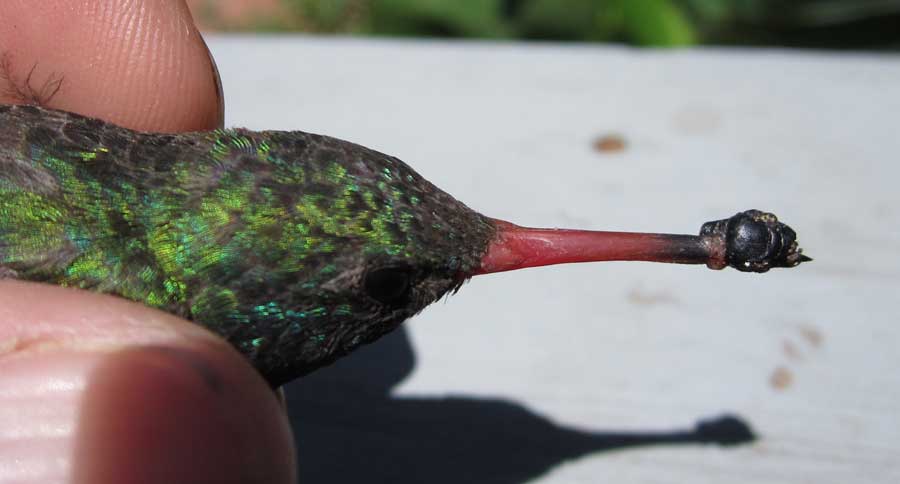
In the yard this morning, as I watched the chickens scratching, pecking, and dirt bathing, I noticed a male Broad-billed Hummingbird that seemed in distress. He flitted from one feeder to the next, trying each of a half dozen in turn without staying long enough for a decent drink. When he finally sat a moment and turned his profile to me, I saw the problem: a crusty black bump at the tip of his bill.

I ran inside and found Tom. "There's a Broad-billed out there with something on his bill! Can you help me trap him?"

Tom watched out the window until the bird reappeared. "The remote control on the trap is still not working," he said. (It got soaked in a ferocious thunderstorm last week and hasn't been the same since.) "Why don't we try luring him into the chicken coop?" Brilliant.

We hung two feeders, one in the doorway and another inside, and within minutes the desperate bird tried to drink from both feeders before flying toward the back of the coop. With a little gentle corraling from Tom, our patient was soon in hand.

The bump is the head of a bee or wasp, shackling the bill and
preventing the bird from feeding properly.
Up close, I confirmed that the lump was the hard carapace of an insect, a bee or wasp. Only the head remained, impaled on the bill. The bird couldn't insert his bill into most feeders or flowers, nor could he open it to catch insects. I'd seen this sort of thing before both in person and in photos, but what I'd never seen until now was injury to the bill from the carcass.
A ring of raw, swollen bill tissue on the body side
of the insect's head is a bad sign.

A hummingbird's bill is mostly living tissue, vulnerable to damage from the sharp edges of the insect's exoskeleton, decomposition of its tissues, or both. This bill looked bad, as though the tip might be necrotic. Removing the bird's handicap would not be easy or painless. A pang of dread clutched at my heart.

Armed with high-power reading glasses and banding forceps, I performed the removal as gently and quickly as possible. The bird cried as the crusty carcass came off in bits, and I kept apologizing for the pain I was causing him (he couldn't possibly understand, but it eased my own pain a little). Once it was off, a little blood welled up in the ring-shaped wound—a sign of healthy underlying tissue. He stopped crying and experimentally licked out his tongue. Definitely a good sign.

I washed the wound, applied a thin film of antibiotic ointment to the top and bottom of the bill (taking care to avoid the edges where it might get into his mouth), and gave him a long drink from a feeder. To recognize him if he visited us again, Tom and I banded, measured, and weighed him. He felt like nothing in my hand, and the scale confirmed that he had been slowly starving. Just 2.8 grams, compared to 3.2 to 3.7 grams for healthy, unencumbered male Broad-billeds that we have banded recently.

The wound looks awful, but the pink color and slight bleeding
are signs of healthy tissue.

Back outside, he lay in my hand for a few seconds before departing. Hummingbirds are tough, and this little survivor is welcome to stay in our yard as long as he needs to recuperate.

Hummingbirds and Butterflies (Peterson Field Guides/Bird Watcher's Digest Backyard Bird Guides)Attracting and Feeding Hummingbirds (T.F.H. Wild Bird Series)

Tuesday, June 14, 2011

Refugees

On this hot, dry, and windy June afternoon, the chickens were restless. Despite my efforts to make them more comfortable—watering patches of dirt for bathing, setting out a bowl of iced apple juice—they wanted more relief and knew where to find it. One by one they hopped up onto the porch and stood by the door, looking longingly through the glass. 

It was uncomfortable for me, too, so I went back inside, locked the dog in the bedroom, and invited the girls into the house. They ate and drank from Sibella's bowls, scavenged the kitchen floor for crumbs, and visited me in the study as I worked at the computer. Pearl was muttering to herself a lot and couldn't seem to get comfortable on my lap. Only when I noticed her trying to mold a nest out of the folds of a serape draped over the dog's chair did I realize that she had an egg to lay and needed to return to the coop.

With bowls of frozen peas and corn as bait (lightly thawed as a cool treat), I lured the girls out the door into dim orange light filtering through a dense column of smoke. Fragments that were once grass leaves, now carbon ghosts, spiraled down to land on the deck. The plume from the Monument Fire, 22 miles to the west on the southern end of the Huachuca Mountains, had been drifting across our neighborhood since yesterday afternoon. In less than an hour it had increased so dramatically in breadth and density that it sent a jolt of fear through me. I hurriedly shooed the chickens into their run, grabbed my car keys, and headed west to see how far the fire had spread.

The Monument Fire in the Huachuca Mountains, as seen from near Bisbee
It was an eerie scene. Smoke billowed up from a broad front on the southeastern corner of the mountains, reducing the sun to a glaring red eye. From my distant vantage point I could see no flames or firefighting activities, but it was clear that the fire was burning the oak woodland and pine-oak forest homes of many of our favorite birds and approaching the houses of people we know.

The order came down this afternoon that residents of the southeastern canyons of the Huachucas would need to evacuate. Human residents will take refuge in the homes of friends and relatives, motels, bed & breakfasts, etc. Livestock will ride out the fire at nearby ranches. Untold numbers of wild creatures will find no sanctuary while the fire rages. Many will not survive, and many that do will have nowhere to return to once it's out.

Residents of the Chiricahua and Huachuca mountains have reported wild refugees fleeing the fires. Bird activity around the town of Portal in Cave Creek Canyon has been very high, and a colleague who lives in the Huachuca foothills reported seeing a desperate-looking Black Bear at his backyard water feature as he was preparing to evacuate.

A hungry Western Tanager
We live too far from the Huachucas or Chiricahuas to expect fire refugees, which is a small blessing. We already have our share of drought refugees, birds and other wildlife desperate for food and water.

This spring, unprecedented numbers of Wilson's Warblers, Western Tanagers, and Black-headed Grosbeaks swamped feeding stations and concentrated along the San Pedro River seeking what little water and food were available in this parched landscape. In our yard, Mule Deer stripped a young mulberry tree of most of its leaves, and Javelinas (a.k.a. Collared Peccaries) ate all the new growth from our few prickly pear cacti that survived the brutal February cold snap. Rock Squirrels were eating all the seed, fruit, and peanut butter dough we put out for the birds, so we began live-trapping them for deportation well beyond the edge of town. We've relocated eleven so far. Cages, netting, and vigilance are the only reasons any of our vegetables have made it this far.

The drought and fires extend well into Mexico, which may be responsible for the appearance of a number of local and regional rarities: a Yellow Grosbeak in Ash Canyon, a Berylline Hummingbird on the San Pedro River, Lucifer Hummingbirds at several unusual locations, and various eastern "vagrants" at others (possibly stranded, unable to find enough food to fuel the next legs of their migrations).

Drought is such a slow-moving disaster that it doesn't make headlines until fires break out. Climate change, too, creeps so slowly that Big Fossil's lobbyists and the politicians they own have had plenty of time to quibble, bluster, and stall, effectively thwarting efforts to avert this disaster in the making. It beggars belief that anyone can continue to scoff in a year of record-breaking storms, floods, droughts, and fires, yet some do.

The past year has fulfilled climatologists' predictions of greater extremes, including wet summers in the Southwest followed by rainless winters and springs. This is a perfect recipe for devastating forest fires. Summer rainfall stimulates abundant growth of grasses, annuals, and shrubs that, once dried, provide ideal fuel, and winter/spring drought creates ideal conditions for catastrophic fires.

It's vitally important to understand that fire is an essential element in many western forests. Southwestern forests in particular need periodic fires to recycle the nutrients in leaf litter and other debris that doesn't decompose in the dry climate. Keeping fire out of these forests is a recipe for disaster, yet that's exactly what we've been doing (first incidentally, then actively) for more than a century.

That said, the fires currently burning are not the kind we need. Natural fires are sparked by lightning from the first dry storms of the summer "monsoon" and usually quickly extinguished by the rains that follow. The current fires are all of human origin, ignited weeks ahead of the rains during our driest, hottest, and windiest time of year. This means weeks of valiant efforts to manage the fire, keep it away from structures and ecological jewels, and "encourage" it to burn in a way most conducive to forest hygiene. Weeks of flames sweeping and/or creeping through our "sky islands."

This is all I can bear to write tonight, but there's more of the story to tell. I'm going to go watch the moon rise and think about Part 2.

Update: I just heard from a friend that the fire jumped Hwy 92 late this afternoon, and that a number of structures have already been lost.

  Fire in America: A Cultural History of Wildland and Rural Fire (Cycle of Fire)  Tending Fire: Coping With America's Wildland Fires  Storms of My Grandchildren: The Truth About the Coming Climate Catastrophe and Our Last Chance to Save Humanity

Sunday, February 27, 2011

Anna's in the snow


A male Anna's visited our hummingbird feeder during this morning's mini-blizzard. He could barely hang on as the feeder swung in the wind and snow pelted his face. Not wanting to make his morning even more stressful, I waited until he left to put out fresh, warm sugar water.

It's been a grim winter for Arizona's hummingbirds. Many died in the Big Freeze of 2011, and many others had to be rescued. Hummingbirds in Tucson and Phoenix, where temperatures rarely stray below freezing, seemed more affected than those wintering at higher elevations. Here at 5000 feet in the foothills of the Mule Mountains, our two or three Violet-crowneds and handful of Anna's managed to ride out the January cold snap, but most disappeared after the all-time record low on the second night of the Big Freeze (0° F./-18° C.).

The following morning's weather was much improved, so I'm hoping that they rode out the worst and departed as soon as possible, as hummingbirds wintering in much colder climates have been observed to do. We're still hosting at least one female Anna's in addition to this male, but there's been no sign of a Violet-crowned since the first day of the freeze (at 8 a.m., during the second feeder change of the day). Even with a bustling clientele of Northern Cardinals, Pyrrhuloxias, Green-tailed Towhees, Gambel's Quail, and many more, the feeding station seems forlorn without an occasional flash of violet blue.

It will be weeks before I can tell how much of our hummingbird garden survived, but in the meantime I'll be escaping waaaay south of the border (Belize and Tikal) for a couple of weeks, leading a birding and natural history tour for SABO.

Wednesday, January 05, 2011

Eared Quetzal reported in Madera Canyon

A male Eared Quetzal with a
madrone berry
near Madera, Chihuahua, Mexico
Here's a little something to spice up winter birding in southeastern Arizona: An Eared Quetzal was reported yesterday afternoon from Madera Canyon in the Santa Rita Mountains.The description was given as "about 200 yards past the Kubo Cabins.....just beyond the stream."

These globally-rare relatives of the Elegant Trogon and Resplendent Quetzal are extremely rare and secretive inhabitants of southeastern Arizona's "sky island" mountain ranges. Though they aren't known to undertake long-distance migrations, several years often pass between sightings.

The last reports of this species in Madera Canyon were from late October through mid-November of 2007. The quetzal was elusive, but vigilant quetzal seekers found other unusual to rare species in the same area (the Patagonia Picnic Table Effect). Andrew Core summarized some of these sightings on his blog, using Google Earth to create highly detailed maps.

Since Eared Quetzals are both greatly sought-after and highly sensitive to human presence, here are a few tips that may make the difference between success and failure for would-be quetzal watchers (updated from posts to BirdChat in December 1999 and BIRDWG05 in 2005):
    Good Birders Don't 
Wear White: 50 Tips From North America's Top Birders
  • Dress in muted, natural colors right down to your shoes, socks and hat. Browns, mid-tone grays, tans, and natural greens are all okay, but avoid white and very light pastels, bright colors, and light blues such as faded denim. If your wardrobe doesn't include any camo, muted plaids and checks are the next best thing.
  • Eared Quetzals are more often heard than seen, so prepare by studying recordings of the bird's calls ahead of time. Xeno-canto has three samples: the first includes the tremolo (a territorial song) and squeal-chucks, the second is mainly tremolo, and the third is mainly squeal-chucks plus a distant flight cackle (and the raspy calls of Steller's Jays). Be aware that the most commonly heard calls—the squeal-chuck and the flight cackle—are signs of alarm. If you hear either of these calls, chances are the bird has seen you and/or another observer and is in evasive mode. Chasing a frightened quetzal is counterproductive. The best strategy is to freeze in place until the bird calms down.
  • In areas where the bird has been sighted, move slowly and as little as possible, stay in the shadows, and keep noise to a minimum. The best strategy is to pick a likely spot, especially near a fruiting madrone (a broad-leafed tree with scaly gray bark and bright red berries), and sit as still as possible in the shade of a nearby tree. Eared Quetzals are extremely stealthy for their size and can fly in quite close to you without you realizing it, so any sudden moves or sounds may result in lost viewing opportunities for yourself and others.
  • Eared Quetzals are very active feeders, plucking fruit on the wing. If the bird approaches a position near a fruiting tree but remains out of sight, be patient - you'll likely have several viewing opportunities once it feels comfortable enough to feed. If you feel you must move to get a look at the bird, do so slowly and quietly, staying as concealed as possible behind vegetation and out of bright sunlight.
  • Prepare for a long wait by dressing in layers, wearing sunscreen on exposed skin, and bringing water and snacks. I guarantee that a good look at this exquisite and globally rare bird is more than worth it.
If you're not a subscriber to BIRDWG05 (the Arizona-New Mexico listserv), you can read the most recent messages at Jack Siler's birdingonthe.net.


UPDATE 1/7/11: Searchers yesterday report no quetzal encounters. This is pretty typical for these shy and mobile birds. With persistence and luck, someone may find a fruiting madrone that the bird favors, making the search not such a needle-in-a-haystack proposition.

Saturday, January 01, 2011

Panic at the playa

It was early afternoon in the southern Sulphur Springs Valley, and the last few hundred of Arizona's largest flock of Sandhill Cranes were returning to their roost at the playa lake at Whitewater Draw Wildlife Area after breakfasting on waste grain in nearby farm fields.

Suddenly, chaos erupts as thousands of cranes take to the air in seconds!

Normal crane chatter rises to a deafening clatter as a multitude of voices raise the alarm.

What could have caused this mass hysteria?

The answer comes gliding through, slicing the panicked flock in two: A Golden Eagle, one of the few predators an adult crane has to worry about.

This scene plays out almost every winter day at Whitewater Draw Wildlife Area, one of the lesser-known jewels in Arizona's birding crown.

The Birds of Heaven: Travels with Cranes  On Ancient Wings: The Sandhill Cranes of North America (Natural History)  Crane Music: A Natural History of American Cranes

Wednesday, December 01, 2010

A close call

Pearl safely back in the run.
Sibella and the dogs up the street had been barking off and on all morning. I figured one of the neighbors' dogs was running loose, but with Sibella on guard I decided to risk letting the chickens out for some free-range time.

They'd been out an hour or so when Sibella sounded the alarm again. When it escalated from a few concerned woofs to hysterical barking, I jumped up and ran to the door. Huddled together on the porch—outside the minimal safety of the fence—were the chickens, and loping casually up the driveway was a coyote.

Ordinarily a visit from a big predator would be cause for celebration, but the chickens have colored our attitudes toward them. We still love and respect coyotes, foxes, ringtails, hawks, owls, etc., but we're also well aware of the danger they pose to our girls. If ever a predator hurt or killed one, we'd have no one but ourselves to blame. That would be hard to live with.

I watched for a few seconds to see if the coyote would turn back toward the house, then opened the door to let the chickens inside and led Sibella into the bedroom (she's not bird-friendly). The girls spent an hour or so in the house, which they love, but could not be persuaded to go back outside, even for a delicious bowl of oatmeal garnished with shredded cheese. I finally had to carry them one by one back to the run.

I'm not sure the girls even saw the coyote. It's their habit to come stand by the kitchen door after they've been out a while, waiting for me to bring out their treats. When other things alarm them—big shadows overhead, quail flushing, etc.—they usually respond by going back into their enclosed run, hiding inside their coop, or taking refuge under the porch or the chairs on the patio. I'm also unsure whether the coyote would have been brazen enough to walk right up onto the porch with Sibella barking from inside, but they're awfully smart critters, and this one was fearless enough to be strolling around the neighborhood in broad daylight.

At any rate, Sibella is the hero of the day, the girls are confined to quarters until further notice, and I'm going to have a restless night dreading the coyote's return. —SW

Extraordinary Chickens Extra Extraordinary Chickens Extraordinary Chickens 2011 Wall Calendar 

Tuesday, November 02, 2010

Arizona voters: Keep politicians' hands off our wildlife!

There's so much at stake this election day, including the future of wildlife management and open space in Arizona. Prop. 109, touted as necessary to protect hunting and fishing from animal rights activists, is a thinly disguised power grab by politicians. It would allow the state legislature to take complete control of state-level wildlife policy and invite lawsuits to overturn laws that regulate hunting and fishing, either of which would be a disaster.

The Arizona legislature hates it when voters keep something out of their hands. Ever since the people approved a plan to reserve up to $20 million each year from the state lottery for state parks and nongame projects (the Heritage Fund), the legislature has tried to get control over the money. After running the state's finances deep into the ground, they finally succeeded in stealing the state parks portion of the Heritage Fund by repealing the statutes enacted by the people. They even stole private money donated toward ensuring a future for our state parks. In a tourism-dependent state teetering on the brink of economic disaster, this is shooting us all in the foot.

But were the politicians satisfied with that? Nooooo. Now they and their special-interest puppetmasters have cooked up this ugly piece of work, Proposition 109:
A "yes" vote shall have the effect of:

1. making hunting, fishing and harvesting wildlife a constitutional right,

2. giving the State Legislature exclusive authority to enact laws regulating these activities,

3. prohibiting laws that unreasonably restrict hunting, fishing and harvesting wildlife or the use of traditional means and methods, and

4. establishing hunting and fishing as a preferred means of managing and controlling wildlife. 
Promoters of 109 insist that they are only trying to protect hunting and fishing from being outlawed by animal rights activists. One problem: There is no such threat to hunting and fishing in Arizona. If there was, and it had any chance of succeeding, how could this proposition have any hope of passage? It's pure paranoid fantasy designed to manipulate naive citizens into supporting the takeover of the Arizona Game & Fish Department and its hunting and fishing revenues by the legislature and special interests.

The vague wording of Prop 109 allows the legislature to bypass the Game & Fish Commission (whose makeup is already under their control thanks to a recent power grab), making the Arizona Game & Fish Department directly responsible to a body of non-biologist politicians who have proven themselves incompetent even at those tasks normally delegated to a legislature. As one commenter said, "These nutballs would screw up a one car funeral."

Conferring constitutional-right status on hunting and fishing, declaring these activities to be the preferred means of managing wildlife, and prohibiting laws that "unreasonably" restrict these activities invites lawsuits over seasons, bag limits, area closures, etc., severely limiting the state's ability to manage wildlife for the benefit of all its residents, not just the 9% of Arizonans who hunt and/or fish (the fourth lowest population of sportspersons of any state in the U.S.; source). Prop 109 is opposed by former members of the Game & Fish Commission as well as mainstream conservation and humane organizations and a number of newspapers, including the conservative Arizona Republic.

The politicians are also trying to get their hands on the Land Conservation Fund, one of our best tools to preserve the best of Arizona's remaining open spaces and the wildlife, rural communities, and quality of life that depend on them. Prop 301 would allow the legislature to subvert the will of the people of Arizona by draining the Land Conservation Fund to apply a pitifully inadequate band-aid to the hemmoraging state budget.

Neighbors, please vote to support wildlife and open space by voting NO on Prop 301 and Prop 109. Don't reward our legislators for their irresponsibility or allow them to make wildlife management any more political than it already is. --SW

Tuesday, October 26, 2010

Coati Tuesdi

Peterson Field Guide to Mammals of North America: Fourth EditionWhat a surprise to arrive at one of our bird monitoring sites overlooking Old Bisbee this morning and be greeted by a chirping troop of White-nosed Coatis! These diurnal, social members of the raccoon family recently recovered from a local population crash, so it's particularly nice to see five healthy-looking "teenagers" with five adult females.

Alternate names include coatimundi (co-AH-tee-MUHN-dee, "mundi" referring to the solitary habits of adult males), tejon solo ("lone badger"), pisote, chulo, chulo bear, and chulo monkey. When you see "monkey" in an Arizona place name, it probably refers to these guys.

Thursday, September 30, 2010

Portrait of a worried dad

This male Lesser Goldfinch has every reason to look worried. He and his mate have a very late nest in the plum tree by our patio, so when I heard an unusual amount of mewing and chipping out there I went outside to see what was going on. The goldfinches were eyeing a Curve-billed Thrasher making its way through the thick foliage toward the nest. Our thrashers don't miss many meals, so I didn't feel too guilty distracting it with a few harsh words ("Hey! I hear your sister is dating a starling!") and convincing it to leave. The finches stayed exactly where they were, still on high alert. Probably not a good idea to go straight back to a nest when the predator might still be watching.

Stokes Field Guide to Bird Songs: Western RegionLesser Goldfinches are one of those those birds whose voices are so delicate that even their harshest calls lay as sweetly on the ear as a song. More sweetly than their own songs, in fact, since these consist largely of other birds' calls. One of our neighborhood males sings rapid-fire songs that consist mainly of flycatcher calls: Ash-throated, Brown-crested, Vermilion, Say's Phoebe, Cassin's Kingbird, Western Kingbird, Western Wood-Pewee. A male that lives in Miller Canyon does a great impression of the "rubber duck" call of the Sulphur-bellied Flycatcher. The phrases go by so fast that the bird may be four or five species further along by the time you can say, "Hey, wasn't that a...?" --SW

Wednesday, September 29, 2010

September surprise


So, yesterday morning I was out on the patio supervising the chickens' free-ranging activities and watching the show at the feeders when I notice this hummer sitting on the far feeder across from a Rufous/Allen's...


Something about it set sirens off in my head. As the Rufous/Allen's backed away, the other bird raised its head in response...


...revealing the long, curved bill of a Lucifer, the first confirmed in our yard in the nearly 15 years since we moved in and put up the first feeders.


A Field Guide to Hummingbirds of North America (Peterson Field Guides)The species nests here in the Mule Mountains, so hopefully we'll see more of them next season now that this lady has found our garden and feeders. With a Calliope that Tom spotted later in the afternoon, our 48-hour hummingbird tally came to a whopping 8 species: Broad-billed, Violet-crowned, Black-chinned, Anna's, Lucifer, Calliope, Broad-tailed, and Rufous (mostly "Rufous/Allen's," but most of the juvenile males are identifiable to species by their tail feather shapes). —SW